Web cookies (also called HTTP cookies, browser cookies, or simply cookies) are small pieces of data that websites store on your device (computer, phone, etc.) through your web browser. They are used to remember information about you and your interactions with the site.
Purpose of Cookies:
Session Management:
Keeping you logged in
Remembering items in a shopping cart
Saving language or theme preferences
Personalization:
Tailoring content or ads based on your previous activity
Tracking & Analytics:
Monitoring browsing behavior for analytics or marketing purposes
Types of Cookies:
Session Cookies:
Temporary; deleted when you close your browser
Used for things like keeping you logged in during a single session
Persistent Cookies:
Stored on your device until they expire or are manually deleted
Used for remembering login credentials, settings, etc.
First-Party Cookies:
Set by the website you're visiting directly
Third-Party Cookies:
Set by other domains (usually advertisers) embedded in the website
Commonly used for tracking across multiple sites
Authentication cookies are a special type of web cookie used to identify and verify a user after they log in to a website or web application.
What They Do:
Once you log in to a site, the server creates an authentication cookie and sends it to your browser. This cookie:
Proves to the website that you're logged in
Prevents you from having to log in again on every page you visit
Can persist across sessions if you select "Remember me"
What's Inside an Authentication Cookie?
Typically, it contains:
A unique session ID (not your actual password)
Optional metadata (e.g., expiration time, security flags)
Analytics cookies are cookies used to collect data about how visitors interact with a website. Their primary purpose is to help website owners understand and improve user experience by analyzing things like:
How users navigate the site
Which pages are most/least visited
How long users stay on each page
What device, browser, or location the user is from
What They Track:
Some examples of data analytics cookies may collect:
Page views and time spent on pages
Click paths (how users move from page to page)
Bounce rate (users who leave without interacting)
User demographics (location, language, device)
Referring websites (how users arrived at the site)
Here’s how you can disable cookies in common browsers:
1. Google Chrome
Open Chrome and click the three vertical dots in the top-right corner.
Go to Settings > Privacy and security > Cookies and other site data.
Choose your preferred option:
Block all cookies (not recommended, can break most websites).
Block third-party cookies (can block ads and tracking cookies).
2. Mozilla Firefox
Open Firefox and click the three horizontal lines in the top-right corner.
Go to Settings > Privacy & Security.
Under the Enhanced Tracking Protection section, choose Strict to block most cookies or Custom to manually choose which cookies to block.
3. Safari
Open Safari and click Safari in the top-left corner of the screen.
Go to Preferences > Privacy.
Check Block all cookies to stop all cookies, or select options to block third-party cookies.
4. Microsoft Edge
Open Edge and click the three horizontal dots in the top-right corner.
Go to Settings > Privacy, search, and services > Cookies and site permissions.
Select your cookie settings from there, including blocking all cookies or blocking third-party cookies.
5. On Mobile (iOS/Android)
For Safari on iOS: Go to Settings > Safari > Privacy & Security > Block All Cookies.
For Chrome on Android: Open the app, tap the three dots, go to Settings > Privacy and security > Cookies.
Be Aware:
Disabling cookies can make your online experience more difficult. Some websites may not load properly, or you may be logged out frequently. Also, certain features may not work as expected.
The demand for digital marketing specialists is booming when today’s employers increasingly seek innovative digital solutions for their marketing needs. The Marketing Department at University of Connecticut's (UConn) School of Business has developed an Advanced Business Certificate in Digital Marketing Strategy to prepare marketing professionals for a successful career in the fast-changing area of digital marketing, including digital analytics, big data and strategic marketing, marketing research, customer relationship management, and targeted database marketing.
The certificate consists of four 3-credit courses and should be completed within three years. Courses are offered on a rolling basis during the Fall, Spring and Summer semesters primarily online, with some courses offered in-person across the Hartford and Stamford campuses.
Please note that this program is not eligible for F-1 visa students residing in the United States. However, you may study in the program online if you complete the program from your home country.
Our courses cover major tools of digital marketing, including search engine optimization, online advertising, and digital social media, and explore innovative digital strategies that apply to branding, segmenting, targeting, positioning, customer satisfaction, and marketing communication. Students learn to develop integrated digital marketing strategies in pursuit of long-term marketing objectives.
Key skills students will develop include:
Using web and social media analytics tools to gain customer and market insights;
Applying up-to-date methods and techniques to respond to online consumer behavior in real time;
Forecasting sales, profiling and targeting customers, and making informed marketing decisions;
Utilizing “big” data tools, such as neural networks, market basket analysis, sequence detection, and text mining.
Applicants must fulfill the following requirement:
Undergraduate degree from an accredited institution AND be a working professional in the areas related to marketing
The Advanced Business Certificate in Digital Marketing Strategy consists of four, 3-credit courses. Visit the Graduate Catalog for full course descriptions. Note that not all courses are available every semester or on every campus.
Required Courses (9 credits)
MKTG 5115
Marketing Management*
MKTG 5665
Digital Marketing
MKTG 5251
Marketing and Digital Analytics
Flexible Marketing Electives (3 credits)
One additional 5000-level MKTG Electives
* Pre-requisite for all other 5000-level Marketing courses
To apply for admission to the Advanced Business Certificate in Digital Marketing Strategy, complete your application via the online application system . Applicants are encouraged to review the prerequisites and application instructions before starting your application. Applications are accepted on a rolling basis and reviewed by the Admissions Committee to the FLEX MBA Program at the campus to which the applicant is applying (Hartford or Stamford).
For more information, please contact:
Laine Kingo
Assistant Director, MBA Student Services
FLEX MBA Program & Graduate Business Certificates
Laine.Kingo@uconn.edu
Phone: 860.728.2442
Pictured from left to right: Jennifer Chiarella, JD/MBA ’14; Angela Balduyck, MBA ’14; Tugba Onder, MBA ’14; Aswathy Mohandas, MSBAPM ’14
Working at the Stamford Learning Accelerator with faculty mentor Brian Brady, a team of MBA, JD/MBA, and MSBAPM students built an executive contact database of 3000 One Stops, their affiliates and local offices across the United States. The database connects each One Stop Center to its corresponding State Workforce Investment Board which provides vital grant funding to these centers and is a potential source of revenue for Access Technologies Group, a Connecticut company whose flagship simulation software product is Simentor.® This simulation software is designed to help individuals who face challenges such as learning disabilities, computer literacy, or explaining a criminal record, enabling them to overcome these challenges and increase their employment opportunities.
Professor Girish Punj with the assistance of Brian Brady, director of the UConn Stamford Learning Accelerator, offered an MBA level experiential learning course at the UConn Stamford Learning Accelerator in collaboration with the IBM Center for Innovation in Visual Analytics. Students interacted with IBM researchers and executives while working on various semester-length projects where they learned and experienced the latest generation of data visualization methodologies. They gained exposure to the rapidly evolving field of visual analytics and learned how to solve business problems using information visualization tools under the guidance of IBM data visualization experts located at various IBM facilities around the world.
“Visual Analytics provided unparalleled access to researchers at IBM who are developing the latest visualization technologies. The course exposed me to ways of representing large and complex data using interactive visualizations making it possible to gain insights and facilitate decision making. Aside from the knowledge gained in the course, the sense of team accomplishment and the accolades received from IBM made it an invaluable addition to my academics,” said Taylor Witt ’05, vice president, digital applications at IBM and a UConn MBA candidate.
“It was a great learning experience to discuss the latest visualization techniques and state-of-the-art visualization tools with IBM researchers around the world through virtual talks,” said Tugba Onder ’14 MBA.
“This was a very hands-on class that focused on visualizing and analyzing big data—which is everywhere, no matter what industry you’re in. You’ll learn a lot in this class from the experts at IBM and from your classmates. The semester will pass by quickly and you won’t believe how much you have accomplished,” said Jennifer Bui ’13 MBA, analyst, ALM People’s United Bank.
Assistant Professor Jane Gu’s Digital Marketing MBA students created their own websites, used search engine optimization, keyword advertising, and social media to drive traffic to their websites, and monitored effectiveness using web analytics. While most students had no web development experience before the class, many eagerly took on the project as an opportunity to build digital presence and to implement digital marketing skills they learned from class. Check out some of the students’ websites below!
Spaghetti Slurper:Matthew Eucalitto is an Italian-American student who grew up in a family that owns Italian restaurants and includes numerous Chefs. Matt developed his website to introduce others to some of his favorite Italian restaurants around Hartford.
Flying on Fridays:Matthew Rader created this website about recreational flying. The website contains information about how to get a pilot’s license and small planes. Matt also maintains a flying blog.
Meg’s Juice Recipes:Megan Blaschke built the website to provide a quick and to-the-point guide to educate people on the benefits of juicing. You can find recipes that Megan recommends and also her tips for juicing.
Hall David Marketing Strategies: Christina Davis created this website for her personal marketing consulting business. Christina also maintains a digital marketing blog.
J Hobbies:Jason Short built this website about his hobbies. In the Orchid section, Jason provides step-by-step instructions illustrated with pictures on how to grow, care for, and breed orchids.
Quality Furniture by Bill: Whitney Ammary redesigned the website of her family business. The website now sells wooden hand-painted accent tables featuring logos of colleges and universities, including UConn.
St. Bear Design: Adam Gooch designed this website to show his artwork and photography, with the hope that viewers will contact him to do design or photo work or go to his Etsy.com shop to buy a print.
The American Outlaws Hartford: Shawn Simao designed an activities hub website for The American Outlaws Hartford Chapter which he co-founded in 2009, providing information on their social club, soccer team, and charitable giving.
Michael Masso, recipient of the Fodor Family Scholarship with Mr. and Mrs. John Fodor.
Scholarship Recipients
John Luke Bogue & Michael Masso, recipients of the Fodor Family Scholarship. Generously given by John and Sally Fodor to provide financial support to varsity student-athletes pursuing a Minor or Certificate in Professional Sales.
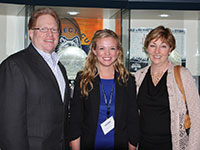
Caitlin Taylor, recipient of the Lander Family Scholarship. Generously given by Mr. and Mrs. Steward Lander to a business student pursuing a Certificate in Professional Sales.
Joshua Lagan, recipient of the Louis J. Barle Memorial Scholarship. Generously given by Mr. Stephen Wood and Ms. Gail Barle to a business student with an excellent academic record and great potential for success.
Katherine Tibedo, recipient of the Jacob M. Duker Award. Generously given by the Duker family to a marketing student for scholarly achievement in the area of advertising and promotion.
Caitlin Taylor, recipient of the Lander Family Scholarship with Mr. and Mrs. Steward Lander
Dayana Peykova, recipient of the Maynard F. Lydiard Jr. Marketing Scholarship. Generously given by Mrs. Barbara Lydiard to a business student with an excellent academic record and great potential for success.
Tina Kulangara, recipient of the Samuel L. Schrager Business Law Scholarship. Generously given by Attorney Samuel L. Schrager to a student with an excellent academic record and great potential for success as a business law professional.
Honors Scholars
Jaclyn Getonga
Nicole Green
Kimberly Halpin
Jaclyn Williams
Outstanding Marketing Scholars
Logan Bement
Erica Chrisis
Paige Gregory
Kimberly Halpin
Joshua Lagan
Benjamin Phillips
Ryan Probst
Morgan Schwenn
Kate Seserman
Stacia Smart
Melissa Smith
Victoria South
Tracey Tassinari
Aileen Tobin
Emily Vasington
Certificate in Professional Sales
Miles Anderson
Danielle Bachar
Robert Bunda
Nicole Crimmins
Nicole Elias
Daniel Feijoo
Mary Kelleher
Katherine Lemus
Brenda Nguyen
Brittani Phillips
Jonathan Sadlon
Junlong Sheng
Christopher Teri
Julia Zaslavsky
Marketing Society Officers
Lauren Samoska, President
Christain Pelliccio, Vice President
Zach Renihan, Chief Financial Officer
Phillip Guay, Secretary
Pi Sigma Epsilon Officers
Scott Margol, Co-President
Brittany Seyfried, Co-President
Rebecca Frutos, Co-Vice President of Administration
Hilary Sunderland, Co-Vice President of Administration
Erica Chrisis, Vice President of Charity
Gabriella Lilienthal, Vice President of Human Resources
The Program for Sales Leadership (PSL) under the direction of William Ryan and Mary Caravella, grew significantly this year, with total enrollment up 24% over the prior year. Enrollments have been climbing as more students become aware of PSL and the career opportunities. Our PSL partners continue to play a key role providing experiential learning support in-and-outside the classroom through sales role plays, an executive speaker series, internships, field visits, and networking sessions. In 2014, we welcomed CDW, a leading provider of technology solutions for business, government, education and healthcare, as a new partner. They join ADP, Altria, AT&T, EBP Supply Solutions, Enterprise, Liberty Mutual, Northwestern Mutual and Tom James.
We are looking forward to another exciting year for our PSL students. Students will compete at the Northeast Intercollegiate Sales Competition at Bryant University and the National Collegiate Sales Competition in Atlanta, GA. These competitions provide our students the opportunity to use their selling, communication, and interpersonal skills in a competitive setting; meet students with similar interests; and engage with corporate partners that support professional sales.
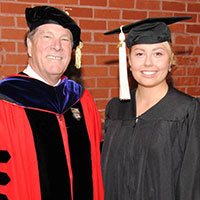
School of Business Dean John Elliott and Brittani Phillips ’14
The Marketing Department is especially proud of two graduating Marketing majors who featured prominently at the School of Business commencement this year! Brittani Phillips ’14, selected to sing the National Anthem, and Joshua Lagan ’14, chosen to deliver the Student Commencement Address, were front and center on Sunday, May 11, at Gampel Pavilion. Brittani Phillips, with years of opera singing training to her credit, performed a moving a cappella version of the National Anthem. Brittani told only her sister that she was performing at graduation, giving her parents and grandparents a wonderfully moving surprise, fitting for the Mother’s Day ceremony.
Joshua Lagan ’14 and Instructor in-Residence William Ryan
Brittani, who completed a Certificate in Professional Selling, has taken a sales position with ADP in Windsor, Connecticut. ADP is is one of the world’s largest providers of business outsourcing solutions. Joshua Lagan, chosen from a very competitive pool of applicants, delivered the student commencement address. Joshua reflected on the encouragement and support that he and others received at UConn from faculty, staff and advisors, preparing them for life after graduation. Joshua began working for IBM after graduation as an Associate Consultant in the Enterprise Marketing Performance Division in Manhattan.
Professor Hongju Liu’s Advanced Marketing Research students worked with Karen LaMalva, director of annual giving at the UConn Foundation, to understand more about donors and their profiles. Using SQL programming and SAS software, the students analyzed the Foundation’s large database to learn more about the timing and nuances of giving practices. The Foundation is hoping to incorporate recommendations from this project into their future outreach strategy. Karen offered praise for the students’ efforts, “I enjoyed the opportunity to collaborate with an undergraduate class on this project. They did a great job and seemed genuinely excited about their discoveries. I was very impressed with the professional nature of their final presentation.” Brittney Seyfried ’14, a student who worked on the project, said, “I was always interested in the research aspect of marketing. Professor Liu helped me understand SAS and SQL to effectively analyze large data sets. I am very thankful for how personalized the class was and for the skills I have gained, as they will greatly assist me in the full-time job I am starting.” This course and other analytics courses provide students with hands-on market research and analytical skills, as well as the opportunity to develop strategic thinking about how to use data to make sound marketing recommendations.
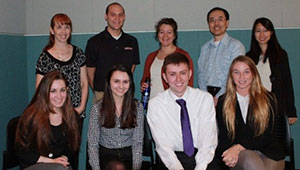
Pictured: Top row from left to right: Karen LaMalva, Director of Annual Giving at UConn Foundation; Daniel Buzzell, Graduate Assistant at UConn Department of Athletics; Christine Buckley, Communications Director, CLAS; Hongju Liu, Assistant Professor, Marketing; Nian Wang, Ph.D. Student, Marketing; bottom row: students Dayana Peykova, Mary Cooper, Marc Castonguay, and Brittney Seyfried.
The Marketing Department has taught digital marketing for almost ten years. Now, with three new hires with expertise in digital marketing (Professors Jane Gu, David Norton, and Hee Mok Park) and growing employment opportunities, we are very excited to offer a Digital Marketing & Analytics Major for business students at the Stamford campus, a Digital Marketing & Analytics Certificate for business majors in Storrs, and a Digital Marketing & Analytics Minor for non-business majors at all UConn campuses. Beginning in Fall 2014, students will be able to enroll in the required courses for these programs, including “Digital Marketing,” “Integrated Marketing in the Digital Age,” and “Marketing and Digital Analytics.”
Charities assisting people perceived as responsible for their plight may have a difficult time attracting donations, says a new study.
With more than $200 billion donated to causes each year in the United States alone, consumers are inundated with donation requests from charities supporting an array of recipients. Contrary to the idea that people who fit the profile of “givers” are uniformly charitable, their donations may be based on information or preconceived notions about the beneficiaries.
“As consumers have limited financial resources to allocate to charitable giving, they may evaluate how ‘deserving’ the recipients are before making donations,” according to William T. Ross, Jr., ING Global chair and professor of marketing at University of Connecticut and the paper’s co-author. “It’s not only the characteristics of the giver that determine their likelihood of donating, but of characteristics they perceive in the recipient.”
The finding contradicts previous studies that have focused on characteristics of people with the option to give suggesting an important boundary particularly among the most charitable—those defined as having a strong moral identity.
Ross was part of a team of researchers led by Saerom Lee, a doctoral student, and Karen Page Winterich, assisting professor of marketing at the Pennsylvania State University. Their findings are published in the latest Journal of Consumer Research.
The team looked at the responses of 600 participants studied in four scenarios.
In one, researchers examined the response of participants who were given an amount of cash to donate to a real nonprofit organization, the Pennsylvania Association of Community Health Centers.
Participants were asked to choose between donating to medical patients described alternately as having a low-level of responsibility for their situations and those having a high-level of responsibility. The recipients were described either as unable to pay for medical treatment because of “low-wage jobs with poor benefits due to economic conditions” or unable to pay for treatment because of inability “to hold a steady job due to their drug and alcohol abuse or gambling addiction.”
The findings indicate that charitable organizations marketing their causes need to be cautious when describing the beneficiaries that they support, particularly if the recipient could be perceived as responsible for their plight and, by extension, undeserving.
According to the researchers, even when charities do not specifically highlight the responsibility of their recipients, consumers tend to assign their own preconceived notions about beneficiaries in stigmatized groups. For example, the plight of the homeless or drug addicts is often attributed to their own behaviors.
The study was funded by a Smeal Small Research Grant from the Smeal College of Business, Pennsylvania State University and is based on the dissertation by author Saerom Lee, which was the winner or the 2013 Society for Consumer Psychology Dissertation Proposal Competition.
Bloomberg Businessweek has named the UConn Business Law program as one of the top ten programs in the U.S.
This ranking is based on survey responses from graduating seniors regarding their learning experiences in Business Law classes. Members of the Business Law faculty have repeatedly earned national recognition from their peers for their teaching methods and classroom mastery.
The Businessweek recognition indicates that students as well as colleagues recognize the unique quality education offered at the UConn School of Business. The Business Law faculty is proud of its contribution to the School of Business and the University and is dedicated to further enhancing its avowed reputation for excellence in the classroom.